Everything you need to know about Leneo, your AI-assisted assessment tool.
About Leneo
Leneo is an AI-assisted assessment tool designed for educational institutions, corporate training programmes, and internal certifications. It automates grading and generates personalised pedagogical feedback, helping teachers and trainers save time without sacrificing the quality or consistency of assessments.
Leneo is aimed at educational institutions and organisations with internal training programmes. It is used by teachers who want to streamline grading time and by leaders who need consistent assessment practices across the institution.
No. Leneo assists the teacher; it does not replace them. Every AI-generated assessment can be reviewed and edited before it is shared with the student. Control always remains with the teacher or trainer. You can see how the process works step by step.
Assessment quality with AI
Yes, as long as the assessment is well defined. Leneo does not assess “blindly”: it analyses each submission against the criteria, rubrics, and pedagogical indicators that the teacher or institution set beforehand. The outcome matches what the teacher would expect because it uses the same parameters. Request a demo to see it with your own activities.
Leneo does not decide on its own what is right or wrong. The teacher defines the assessment criteria (achievement levels, indicators, rubrics) and Leneo applies them systematically to every submission—like always grading with the same guide in front of you, without fatigue-driven variation.
It is personalised. Leneo analyses the specific content of each submission and generates comments tailored to that answer, not copied boilerplate. The student receives observations on what they did well, what they can improve, and how, based on their own work. You can verify this yourself by requesting a free trial.
Yes, especially for those activities. Leneo is particularly useful for extended tasks, essays, and argumentative answers, where manual grading takes more time. Because it follows teacher-defined criteria, assessment stays coherent even when interpretation is needed—something hard to guarantee when dozens or hundreds of submissions are graded by hand.
The teacher always reviews the assessment before it reaches the student. Leneo does not publish anything automatically without human oversight. If a grade or comment is not appropriate, the teacher can edit or correct it before sending. You can see how this review process works in detail.
Assessment is almost immediate once the student submits. Leneo processes the content in seconds and makes the result available for the teacher to review—no queues or waiting for manual turnaround.
Pedagogical adaptation
Yes. Leneo is configured for each institution’s context. Feedback language, assessment criteria, and level of demand follow what each teacher or centre sets, so it applies equally in primary, secondary, or higher education. See use cases for concrete examples.
Yes. Leneo is configured with the criteria, rubrics, and pedagogical approach defined by your institution. The AI always assesses against the parameters you set—not generic preset criteria.
Leneo works with the content and criteria your institution provides, so it is not tied to a fixed curriculum. If the teacher defines learning objectives in Spanish and aligned with their region or country’s curriculum, Leneo assesses within that frame. If you have questions about your specific case, write to us and we will confirm.
Leneo can assess texts, essays, attachments, quiz answers, forum participation, and other common formats in digital learning environments.
Yes. Leneo analyses content and how well the activity criteria are met—not only surface form. If spelling and written expression are criteria in your rubric, it will assess them. If not, it will not penalise them automatically. You decide what is assessed and what is not.
Yes, if you configure it that way. You can set educational level and tone so Leneo adapts feedback language to your specific students.
Technical integration
Leneo is available as an official Moodle plugin, via API integration for other LMSs, and as custom applications tailored to each institution.
Leneo is compatible with Moodle (TO COMPLETE) onwards. We recommend keeping Moodle up to date for reliable plugin behaviour and the latest improvements. If you are unsure about your current version, our technical team can advise before installation.
Not if you use the Moodle plugin—it installs like any other add-on. The Leneo team supports installation and initial configuration, so teachers and managers do not need technical skills to start assessing with AI from day one. Contact the technical team if you have questions about your environment.
It works inside Moodle as another plugin. You do not need to change how you work or learn a brand-new tool from scratch. Assignments work the same for you and your students; Leneo works in the background and shows results in the platform you already use.
Essentially Moodle or another LMS in operation, or the ability to integrate an API. Installation, configuration, and initial training are handled by the Leneo team. Rollout is designed to be quick and not disrupt everyday teaching. You can see how integration works step by step.
Media pending · integracion-paso-a-paso — Integration step by step (image or video)
Results are delivered as PDF and/or editable documents, directly in Moodle or via API to connected platforms. Teachers receive them before students so they can review and approve.
Yes. Scalability is a core strength. Leneo can process assessments at scale while keeping the same criteria, coherence, and quality per response—valuable for large cohorts or many parallel groups. Request information for your specific case.
Privacy and security
Leneo is designed to integrate securely in institutional environments. Data is not used to train external models or shared with third parties. If your institution has specific privacy or compliance requirements, you can read our privacy policy or contact the team for guidance during deployment.
Accountability and trust
Leneo does not produce free-form, improvised marks. Each assessment is built from the criteria and rubrics you defined, so you can trace why each score was given. The teacher also reviews the result before it reaches the student, which lets you catch and fix any grading that does not make sense before publishing.
Leneo still assesses against your defined criteria and flags aspects that need closer human review. It does not make final calls on doubtful cases—it highlights them for the teacher. Human oversight always has the last word.
That depends on your institution’s policy and what you choose to communicate. Leneo does not impose restrictions here. What matters is that the final assessment always goes through teacher review, so the AI never decides the grade on its own.
The teacher publishes the assessment and therefore stands behind it. If a student disputes, the teacher can review the criteria applied, justify the grade, or change it if appropriate. Leneo provides a detailed record of why each score was assigned, making it much easier to explain or defend a grade to students or families.
The teacher, as with any other assessment. Leneo is an assistance tool, not an autonomous agent. The grade the student sees is the one the teacher reviewed and approved. Supervision is not optional—it is essential and ensures pedagogical responsibility remains with the teacher.
Yes, and it should become easier over time. Leneo does not replace teacher judgement; it supports it. The final assessment always passes through you before reaching the student, meaning you validate and stand behind it. Using assistance tools for grading is comparable to calculators in maths or spell-checkers in language: supports that do not remove the teacher’s professional responsibility.
Leneo is a Beessync product and is currently being rolled out in educational institutions. If your centre needs institutional validation or references from other schools using Leneo, contact the team for the information available.
Day-to-day use
Yes. Leneo is designed primarily for Spanish content and supports other languages through the underlying AI models. Feedback is generated in the same language the student used in their answer, adapted to each institution’s linguistic context. For multilingual use cases, ask our team about available configuration options.
It depends whether you already have a rubric or assessment criteria defined. If you do, setup takes minutes. If you start from scratch, configuring Leneo itself helps you structure criteria clearly. Once an activity is configured, you can reuse or adapt it for others without starting from scratch.
Yes. Leneo records all assessments and lets you access them at any time—useful for tracking a student’s progress through the course or reviewing past assessments if a dispute arises.
Yes. Rubrics and criteria you configure in Leneo can be saved and reused across activities or courses—especially time-saving after the first use, when you already have your own assessment models defined.
Leneo focuses on pedagogical assessment, not plagiarism or generative-AI detection. If you need that, combine it with a dedicated tool for detecting AI-generated content, of which several exist on the market. Ask the team which solutions are compatible.
Reports and tracking
Yes. Leneo includes reporting, metrics, and audit features so teachers and institutions can analyse overall performance, spot learning patterns, and improve teaching processes. Request a demo to see the reports in action with real data.
Licensing and procurement
Leneo is offered under a commercial licence per institution or campus, including technical support, onboarding, and installation. Contact us for terms and pricing.
Yes. Request a free trial by writing to the Leneo team. Response is quick and without obligation.
The free trial lets your institution explore Leneo in a real environment with support from the technical and pedagogical team.
During the trial, access is limited to a certain number of students and duration—enough for teachers and technical leads to validate Leneo meaningfully before deciding. Ask us if you need a wider trial scope.
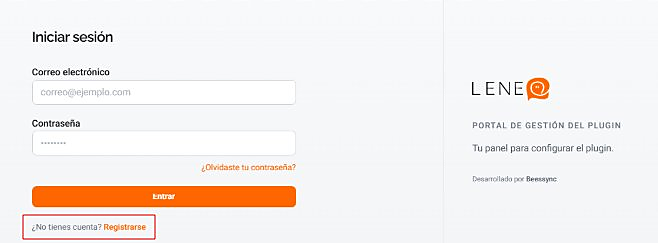
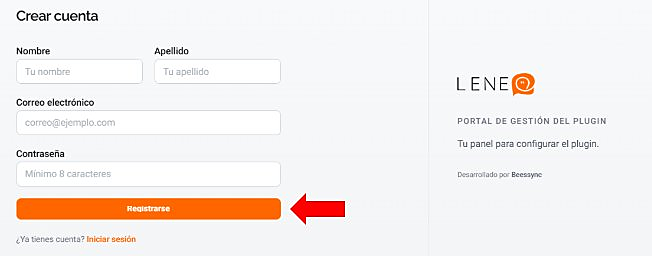
Enter your first name, last name, and password, then click the sign-up button to create your account:
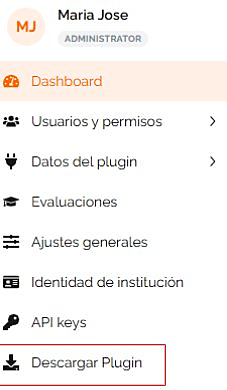
After signing in to the admin panel, open the side menu and select Download plugin.
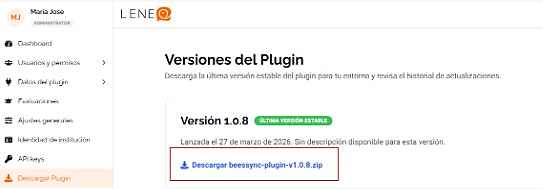
In that section, find Latest stable version and click it to start the download automatically.
We recommend following the installation video tutorial. There you will find a step-by-step guide suited to your Moodle version.
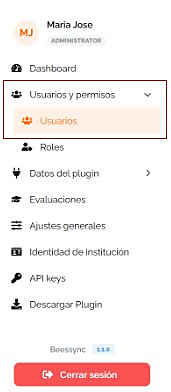
In the panel, go to Users and permissions in the left menu and open Users
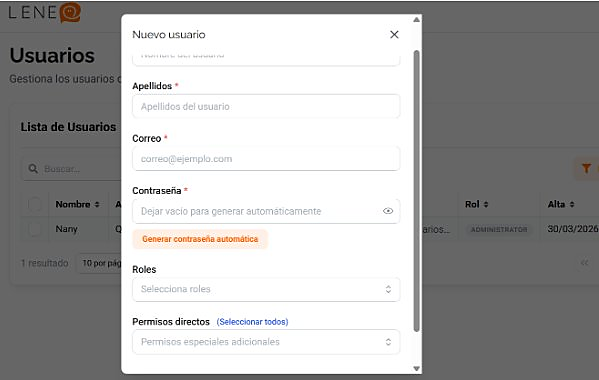
Click Create and fill in the required fields.
Once created, you can edit the user or adjust their information at any time from the same section.
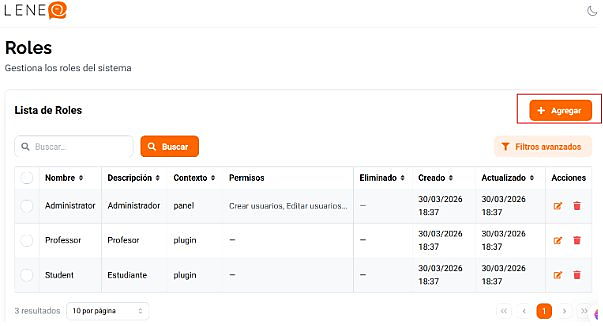
Open Roles in the main menu and click Add.
Complete the required fields and choose the role scope: Panel or Moodle, as appropriate.
Open Plugin data from the menu. Click Users to see the list of users already created. In the Actions column, use the icon to open Direct permissions. From there you can enable or disable permissions per user. For this process, follow the steps shown in the following video:
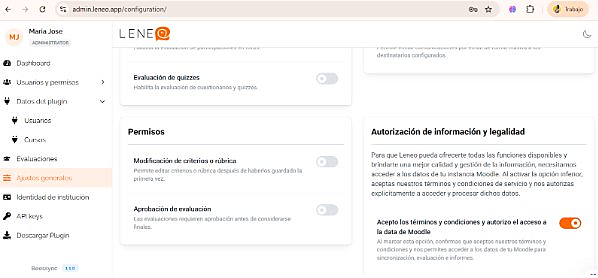
💡 Important: Before finishing, accept the terms and conditions under General settings.
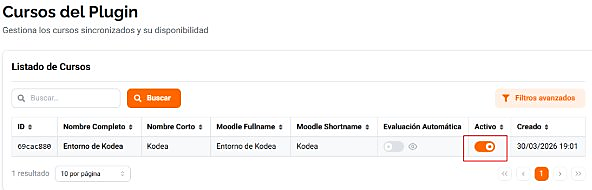
In the panel, go to Courses.
Find the course you want to activate and, in the Activate column, click the corresponding button. The course is enabled immediately.
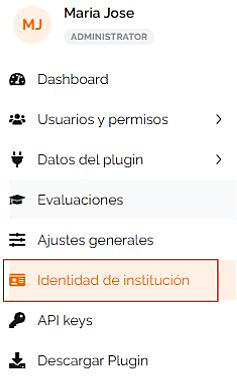
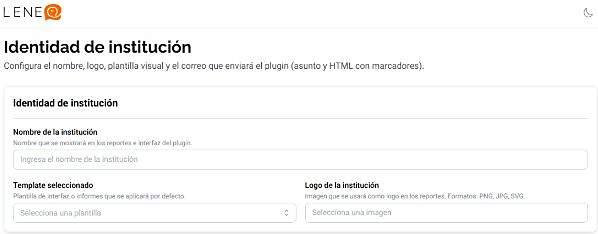
From the main menu, open Institution identity
Complete the required fields with your organisation’s details. This personalises Leneo with your institution’s information.
Configuration
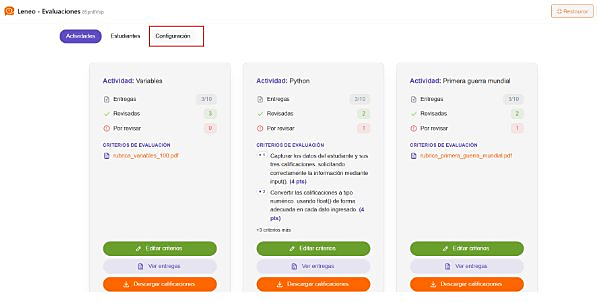
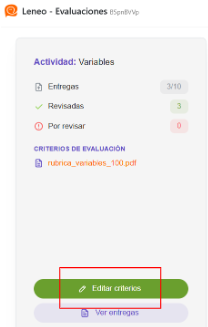
With the Leneo block installed, open the plugin from your Moodle course. You will see course tasks and their submissions. Select the task to configure and click Edit criteria. Complete the required fields: you can define criteria manually or by inserting an existing rubric that contains them. Then open the submissions panel and click the review button. For this process, follow the steps in the following video:
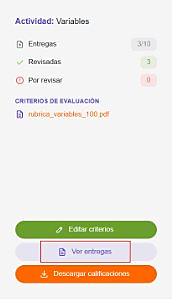
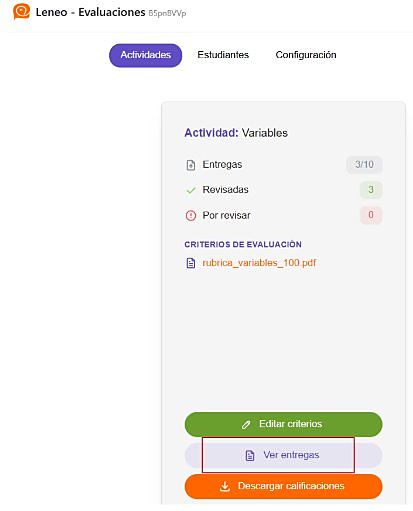
Inside the Moodle plugin, first click View submissions for a specific activity:
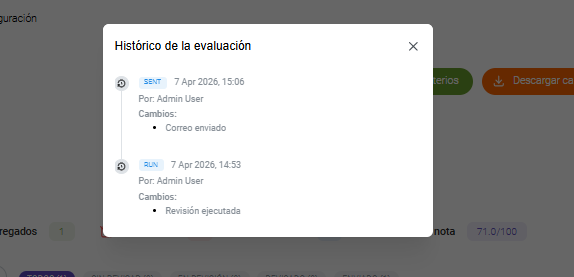
That opens the assessments view with the student list. Then, in the Actions column, go to the student row you need and click the history icon to open revision details.
After clicking, you will see the assessment versions:
In the assessments view, check the Status column; if the label Sent appears in green, the assessment was delivered successfully.
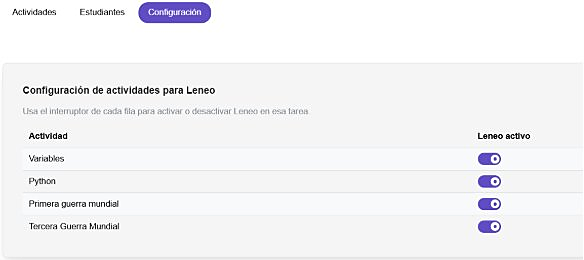
You can configure this with the Settings button at the top of the screen.
There you can turn Leneo on or off per task with the corresponding switch, choosing which assignments use the plugin and which do not.
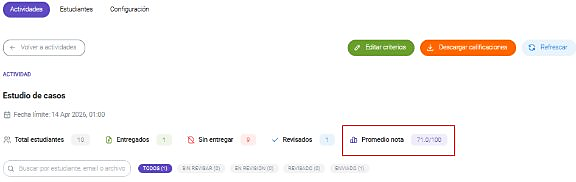
The grade average is at the top of the activity view, in the summary bar, labelled Average grade with its value.
To set a revision limit, first click General settings in the left menu of the settings panel:
Then scroll to Revision limit, find the field Number of revisions allowed per assessment, and enter the desired number (for example, 3).
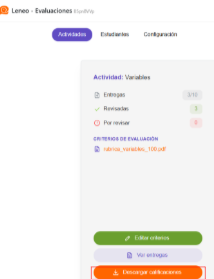
You can view and download grades in two ways: first, from the activities overview, click Download grades for the activity
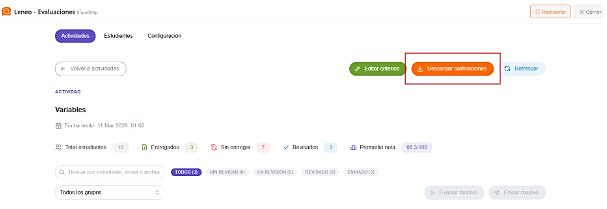
Second, open the activity via View submissions
There you can use Download grades at the top right:
In both cases, a window opens to view grades and export as PDF or CSV:
Inside the selected activity, go to the student row whose result you need and click View result.
A window opens with the student’s assessment detail; this view is read-only and can no longer be edited.
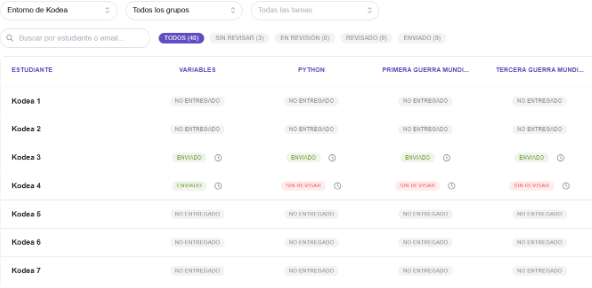
In the Students tab you can see each student’s status across all activities; each column is an activity and shows whether the submission is sent, not reviewed, or not submitted—giving an overall view of progress and assessment status.
You can also use the filters at the top to segment by course, group, task, or status for a more specific review.
Yes—click Edit criteria:
A window opens where you can change the activity description, learning objectives, and assessment criteria.
Changes apply only to future reviews and do not affect assessments already completed.
Yes—in Edit criteria you can set the feedback tone students receive by choosing an option from the dropdown (for example friendly, professional, or motivating).
Yes—in Edit criteria, go to Rubric (optional) to upload a PDF or Word file (.doc, .docx). You can upload a new rubric with Choose another file to replace or keep the current one if you make no changes.